Edit: I've added some text at the bottom, in response to a query made by a friend from Chennai.
Apologies for the missing image - to those who've been wondering what happened to the post :) Made some minor modifications. Plus added a close up. Thanks for looking!
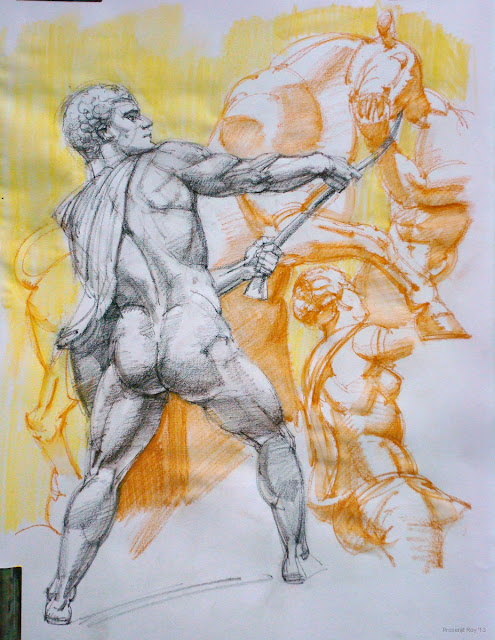
19" x 13", acrylic on canvas paper. Life study
Added text (copy-pasted from elsewhere):
"@ GS - as usual, you provoke a deeper look into the work, which gives
me food for thought. All I can say is that, working from life provides
you with a huge amount of info to choose from. While that may be
overwhelming in the beginning, with (informed and alert) practice, one
slowly tends to learn what to keep/emphasize, and what to
ignore/downgrade. The tendency of portraiture students like me is to
first look for a likeness, which should be the least of one's worries.
Likeness ought be incidental, not as a result of conscious effort -
ideally.
If I can get the head
structure right, where the
bony sockets/protuberances are in proper relationship to each other...
that will be reflected on the soft tissue part. Once the shapes (both
the outline and inner, overlapping ones) have been drawn satisfactorily,
so that the eyes/nose/mouth are in proper horizontal/vertical/angular
relationship, one moves on to work out the basic
value separations i.e. identifying the lit from the unlit areas. Once this is done, one has to work out the
half-tone areas,
which are lit... but not 'high-lit', if that makes sense. The
shadows/unlit areas, which were painted in a medium value darkness, are
then further
defined with darker darks. The lightest areas in the shadow must be darker than the darkest area in the lit portion.
Now, the progression of unlit to lit portion (i.e. the shadow
junction area) may vary according to the curvature of the surface - its
gradual where the turn is gradual, but quickly becomes lit with the brightest value where the
turn is sharper. That has to be worked out as well.
The illusion of solidness
you've referred to only comes after all this foundation work has been
laid. You may then make those subtle value (and thereby, hue) changes,
indicating minor, but very powerful topographical undulations. The
latter works effectively only then, although it looks as if those
subtleties are all that makes the difference between a good and an
average work (mind you, I'm not all that happy with this one, so I lay
no claim to it being 'good'... I'm just speaking in general terms :) )
As regards knowing where to put what ('choosing those spots') I think
this is a skill which continues to develop as one becomes more and more
aware of anatomy - '
the eyes do not see, what the mind doesn't know',
its said! I can't emphasize on this fact strongly enough. An
ever-expanding knowledge of artistic anatomy has a deep effect on one's
figure work, which no amount of photo-realistic surface treatment
(alone) can compensate for - its lack becomes apparent to the discerning
viewer, despite a great deal of skill at rendering minute surface
features. The work, if not sound structurally and functionally from
within, will often end up looking like a superbly painted plastic doll, a
shell without life.
Before I end this rant, here's
a link to one of Bouguereau's nudes... the subtlest topographical changes are mind-boggling, and are often
only partly apparent unless one tries to copy it in pencil or
(preferably) paint. But under all this is Bouguereau's exacting
standards for anatomy... this man didn't leave a single stone unturned
in that regard. And yet, its all so very understated!"