Showing posts with label 'old master study'. Show all posts

Thursday, December 14, 2017

Sculpture turns into Galatea

Sculpture to Galatea...

A Reinhold Begas sculpture study turns into Galatea of The Pygmalion (things kind of happened on their own!)

28 x 22 inches, acrylic on paper.


Close up of head...


Wednesday, August 31, 2016

Decoding a complex pose

A fellow artist (cartoonist) had requested me tips on how to go about 'untangling' and study this digital sketch of mine, which was an adaptation of a little figure study by Vinayak Karmarkar (the late, great Indian sculptor whose works I've recently studied at Sasawane, Maharashtra). So I posted a reply along with a few digital sketches, to explain how I went about doing it. I hope this will also be of some use to my kind visitor(s).

The digital sketch... (done with Mypaint 1.0 software and Wacom pen/tablet)


And my reply...

Hi, many thanks!

Indeed, a deceptively complex pose - worthy of study with ball or digital pen :) Below is a pic I have taken of the plaster cast kindly gifted to me. I did the study from a slightly higher point of view, but I think you'll still get an idea of how very 'tangled up' the pose is! Further below I've posted a few digital sketches, trying to break up (and clarify) the pose a little. Hope it helps.


Here I've omitted the upper limbs to give a clearer (albeit highly schematic) picture of the vertebral column (how it bends), the pelvic structure, the bending of the legs and the overlapping of feet. The red arrow indicates how the neck should bend forward, so that the chin may rest upon the left knee.


Here I've fleshed out the figure a little with the white outlines. Morever, the curved arrows in white indicate the various actions taking place in the pose e.g. curling of the right hand under the right leg (near ankle); of the left hand under the left toes. Since the vertebral column is bending forwards, its spines (not visible) will tend to stick out in the back, while the abdominal flesh/muscles will be compressed - thereby developing deep flexure lines. There is also pushing out/bulging of flesh here and there due to compression at various flexure sites (I have to say, as a cartoonist, you're already aware of squash and stretching, although in a different context)


The last pic further clarifies what I've mentioned just above. The flesh sticking out in the gluteal region to her right is a combination of muscle and fat, being compressed between the floor and her upper thigh, and between her pelvis and thigh. The extent of this bulging will vary between subjects and between genders. Similar bulging due to compression is seen in the abdominal area, and where the knees are flexing.


In my final study (on which you have commented, and which is posted at the top), the effect due to clothing is superimposed upon the naked figure. Of course, one needs to learn to visualize the underlying structure - bones, muscles, flesh and skin, in order to design the drapery more efficiently. I think, some amount of direct observation along with studied knowledge can help us decode any pose, however tangled/foreshortened. Thanks again for asking :)

Wednesday, July 13, 2016

Studies on sculptures by V.P.Karmarkar

I've already posted the entire series of study work on my website. Here's a few of those, especially selected for the figure art gallery. These are studies based on the late, 20th C Indian sculptor V.P.Karmarkar, whose work I admire a lot. I went to live in his ancestral village of Sasawane, which is on the Arabian Sea coast and on the opposite side of my country (I live near the eastern coast of India). For a couple of weeks, I was studying his works, which are lovingly displayed in the Karmarkar Museum. I'm indebted for this opportunity to Sunanda Karmarkar, 81, the museum's Director and a most kind and gracious lady. She's also the daughter-in-law of the great sculptor.

20" x 12", acrylic on canvas paper

Same as above, a close up view

A3, inktense watersoluble blocks on paper

20" x 12", acrylic on paper

A3, watersoluble blocks on paper

Sunday, March 22, 2015

Study of 'Nature Revealed'

(I intend to add more studies to this thread... )
-----------------------------------------------------------

Study of 'Nature Revealed', a 19th C sculpture by the French master L. E. Barrias.
30" x 22", pastels and conte on paper.


Study of 'The First Funeral'

30" x 22", pastel on paper. This is a study sketch of L. E. Barrias' 'The First Funeral' (1878). I was in total admiration of the complexity of different forces - gravitational and muscular, which are interacting with each other to make this beautiful composition possible. I'm sincerely thankful to the unknown ref sources which helped make this study.

Notice how the central male figure is tilting back (please click to access the full size), while supporting himself from falling forwards (due to the drag of the deceased's weight) with his left leg. His abdominal muscles are taut, to counteract the action of his back muscles (responsible for the backwards tilt). The deceased is completely under the influence of gravity, as is evident from the curvature of his spine, the slight inward bend of the left foot, the position of the wrist/fingers on his lap, and the posture of his head/neck. The female figure is slightly bent forwards, kissing the deceased on the side of his head. Therefore, her weight is mainly on the right leg, which is straight and taut, while the left leg is comparatively relaxed. Also, the male figure's head is erect, the neck muscles stiff - showing the strain of the weight he's carrying. He has a melancholy look on his face, as he glances down at the departed person.


Friday, March 13, 2015

Nymph and Satyr - conte study

One large (30" x 22"), in-camera conte drawing of an Old Master sculpture. This is Claude Miguel's (18th Century, French) sculpture 'The Nymph and Satyr'. I was trying to record my process, and had that irritating video cam peering over my shoulder most of the time.


Including one grayscale image for value comparisons:


Monday, November 24, 2014

2 acrylics

Just two acrylics from a couple weeks ago... (have already posted these on my website week before last).

1. Tree - 24" x 18", acrylic on canvas. Imaginary composition, figure, light, landscape.


2. Terracota Venus - 20" x 28", acrylic on paper. Just my take on Praxiteles' Aphrodite, housed in the British Museum. Many thanks to the various unknown image references I've used to study this immortal sculpture.


Monday, October 27, 2014

11 studies of sculptures

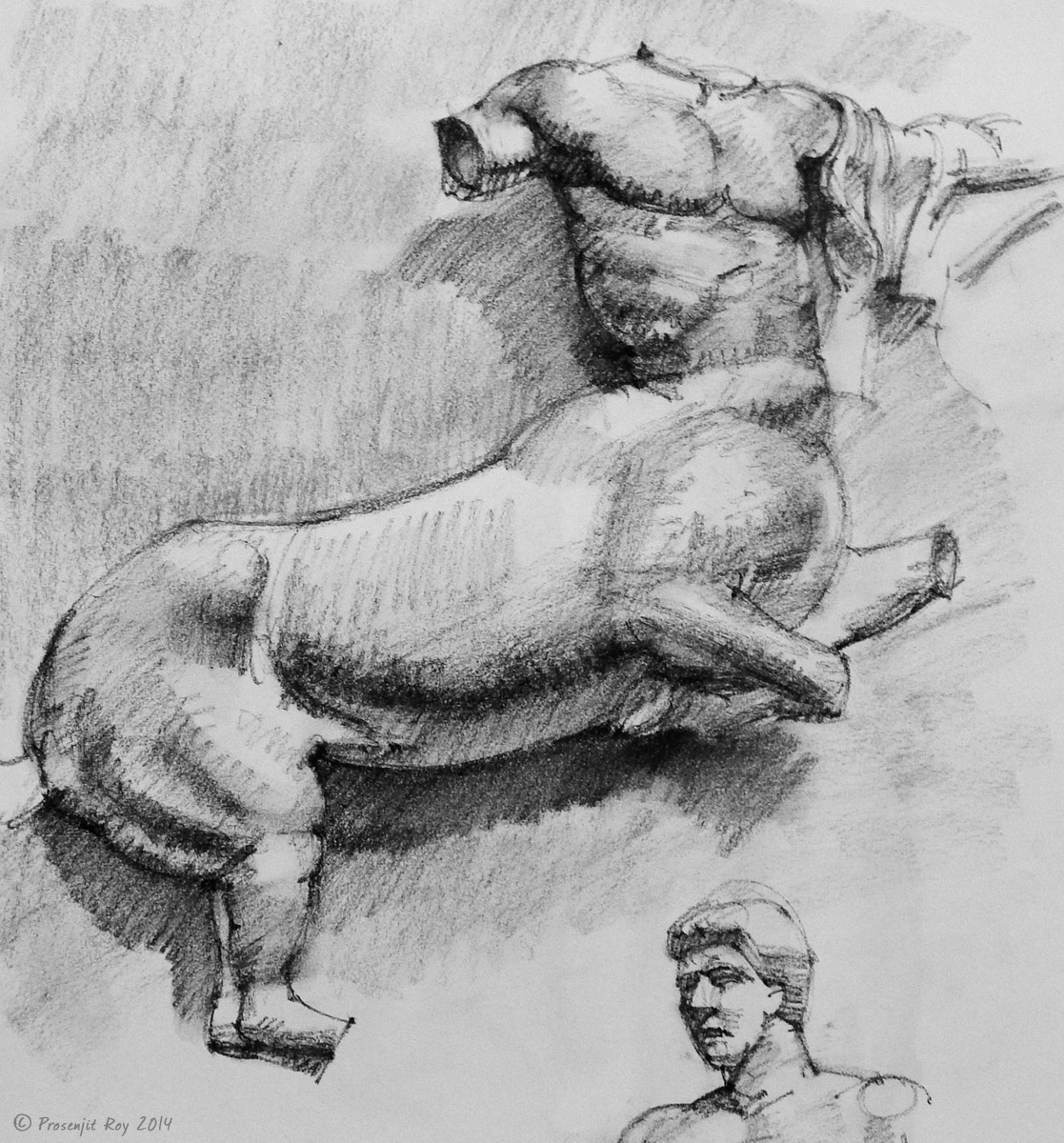
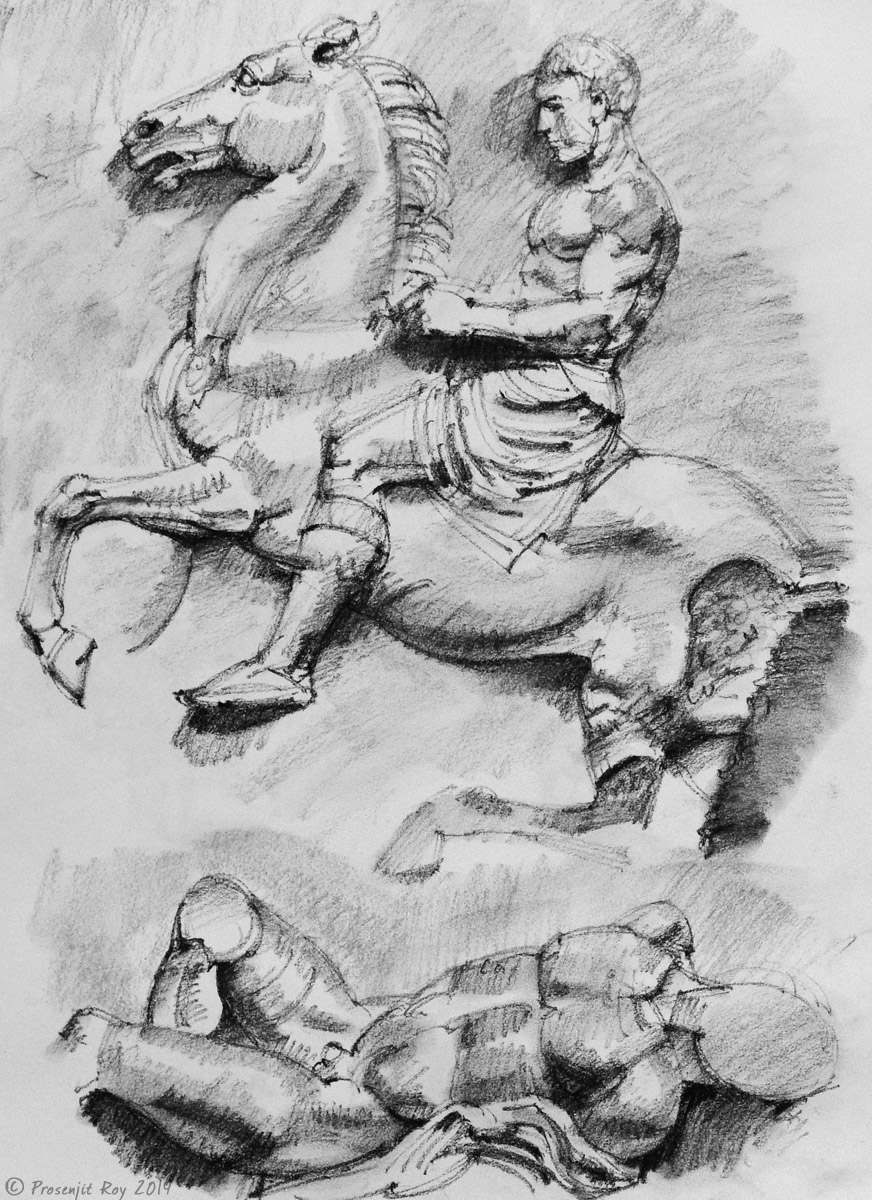
A number of sketches studying the various 'Parthenon Marbles' (British Museum), Plus a few others.

A3, with compressed charcoal, pastel, or conte. From various unknown ref sources, my heartiest thanks to all of them for helping with my studies.


Friday, August 1, 2014

Drapery studies and 'two graces'

 A couple of drapery studies, followed by a study of Rubens' 'Three Graces' (only two were drawn though!). As regards the drapery, I was being aware of the form underneath, while trying to understand the logic of the 'flow/fall' of the overlying drapery, and also how the thickness of the cloth influences both form and flow.

1.


2.


3.


----------------

Ref images by kind courtesy of - 1) Jamari Lior (jlior) and 2) Lockstock, in Deviantart.


Thursday, November 14, 2013

2 pastel studies, old master sculptures

A couple of old master sculpture studies, in two different kinds of pastels - oil and dry.

 22" x 15" (half sheet) hard pastel on tinted paper. Referencing M.J.Ezekiel's 'Eve hearing voices' (bronze).


22" x 15" (half sheet) oil pastel on paper, tinted with acrylic. Referencing Bertel Thorvaldsen's Venus with apple, marble (took liberties with the apple... crop posted just below).


Many thanks to the ref photographers (who are unknown to me) for helping with my studies.

Monday, July 29, 2013

Three assorted sketches

From today's work, those not sent to the scrap heap....

All in A3 size paper, using watersoluble pencils/leads

After an oil by William Orpen


Study of the Belvedere torso


Just a quickish leg study


(many thanks to unknown photog of the source ref)


Monday, May 27, 2013

Assorted sculpture study sketches

Assorted study sketches of various master works... mostly in charcoal on A3 pages... I've indicated the sculpture's creator in the image itself, wherever I could.

1. Vinayak Karmarkar's work never ceases to amaze me... its like he depicts figures in that very, ethereal instance when live human beings, as if by some magic, are turning into stone! Some text on him I wrote a number of years back...


2.  Jean-Baptiste Carpeaux, another master I've come to admire very much..


3. En pénitence - unknown. That penitent kid (I noticed only while drawing) has feet of what could be a deer or goat. Regretfully, the allegorical/mythological aspect of this delightful work is something I've not yet looked up


4.


5. Ref was small and burnt out


 6. The figure was so beautifully rugged, I decided to draw it accordingly


7. Another Karmarkar... not happy with this one :/ Also, her feet weren't visible in the ref, so I had to improvise.


8. The final form of this is in the previous post... wasn't really looking to make this into a finished drawing, just gathering as much information as I could for the subsequent paint layers.


9. The central figure is probably not part of sculpture study :|


10. Amazing sense of symmetry in this timeless work!


My heartiest gratitude to the various ref sources on the internet, wish I could thank them individually.