Tuesday, January 2, 2018

Stark

14 x 22 inches, acrylic on paper.


Black & White reference image by Eric (epsilon3-artphoto in Deviantart), photographer, and the wonderful model who have kindly allowed me its use for study. Many, many thanks!


Thursday, December 14, 2017

male torso study with sword

One male torso study in acrylic (Clothing, sword, neck posture added)

14 x 22 inches, acrylic on paper.


Close up...


* Couldn't trace ref source - many thanks to unknown photog/model for helping with the study.

Sculpture turns into Galatea

Sculpture to Galatea...

A Reinhold Begas sculpture study turns into Galatea of The Pygmalion (things kind of happened on their own!)

28 x 22 inches, acrylic on paper.


Close up of head...


One more figure study in acrylic, Oct '17

One more figure study in acrylic...

28 x 22 inches, acrylic on paper.


Slightly modified from Ref by kind courtesy of 'R', Voivodess_Stock in Deviantart.

Thursday, October 26, 2017

More acrylic studies

More figure studies in acrylic -

A) Study of a tangled-up pose :
14 x 22 inches, acrylic on paper.


Unknown source reference - I wish I could credit the photgrapher/model, the pose was too good not to study. Very educational.

B) Color study - adpatation from Black & White reference.
14 x 22 inches, acrylic on paper


Ref image by kind courtesy of Michael Schalla on Deviantart.com

Thursday, October 5, 2017

Figure study in Acrylic Sep'17

'Adhira', figure study in acrylic - 22 x 14 inches, on paper


Study from a reference by Maureen and Douglas Johnson at livemodelbooks-dot-com.

Wednesday, May 10, 2017

One more figure sketch from April 2017

More figure sketches in acrylic...
1/2 sheet, acrylic on paper. Directly sketched with brush using Burnt Umber.


Reference by kind courtesy of Larry Withers of Onairvideo.com


Thursday, April 6, 2017

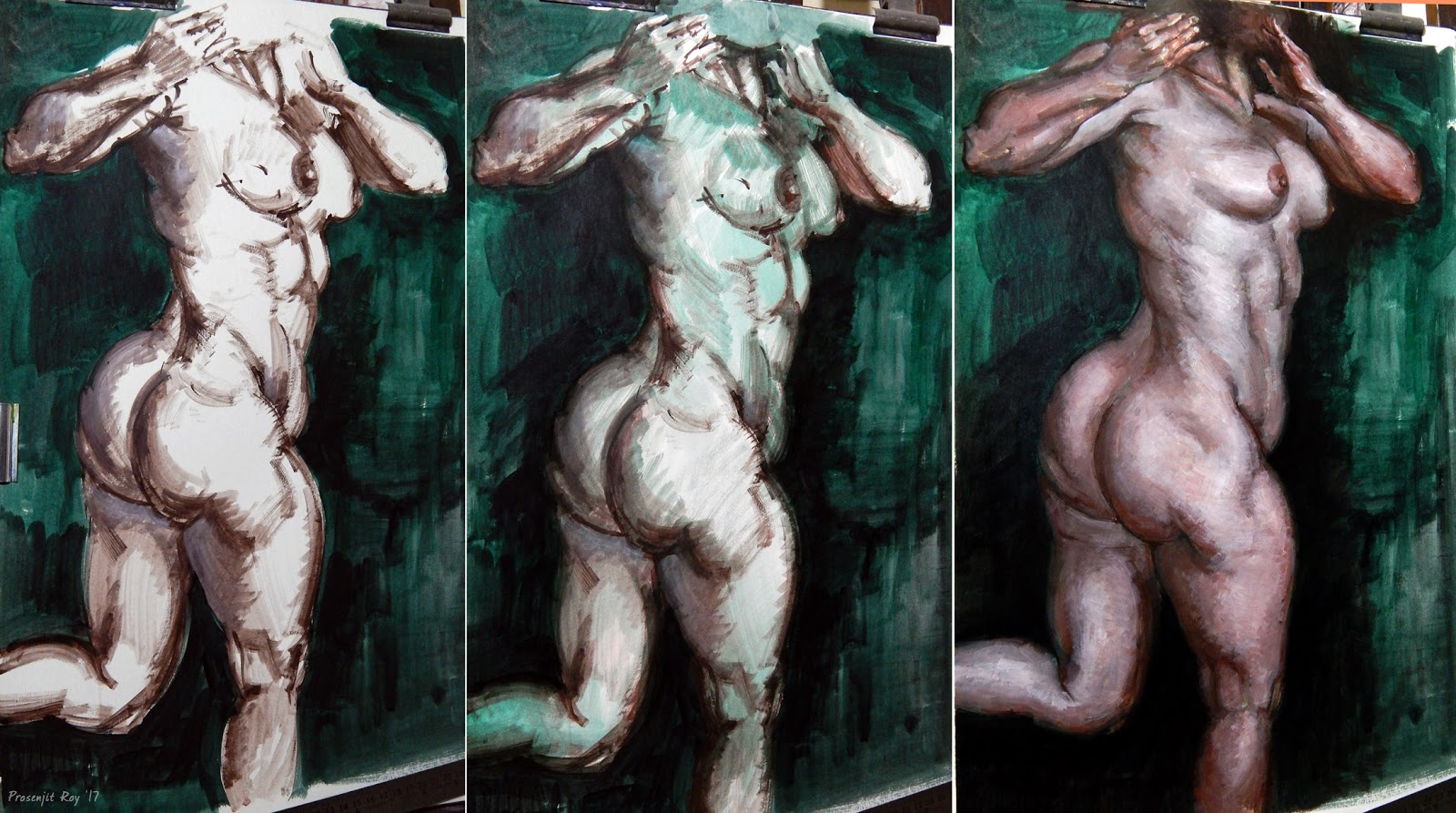
Torsion - study in acrylic


The 'work in progress' pic is posted at the bottom.
1/2 sheet, acrylic on paper.


A couple of close-ups (you may click to see details in the enlarged version).


The W.I.P shots, in three stages: As you can see, the initial drawing was directly made with brush and burnt umber. At stage 2, more of the background was brushed in using a mix of pthalo green and black (arbitrary choice). Some of this was brushed onto the figure in thin layers, so as to integrate figure with background (helps to take out sharp, cutout-like, sharp edges). Stage 3 shows the finished painting.


Many thanks to Marion Skydancer of deviantart for the reference image.


Monday, November 21, 2016

Figure study in acrylic with WIP

Full sheet, acrylic on buff cartridge paper. Minimal palette - black, burnt sienna, titanium white (and traces of burnt umber).


Here is a three image Work in Progress sequence of this painting:


From above downwards : I began cursorily by pegging the perimeter of the figure, directly using brush and some ivory black (which was left over on my palette from an earlier session). I located the extremities e.g. top of head, right elbow, right shoulder, right toe, right knee, left toe, left knee, left shoulder (in that sequence) by points, and joined these to make a rough polygon. The figure was to be contained within this perimeter. Having drawn the figure, directly with brush, I made some sketchy tonal studies to glean info on the values.

Then I began to add color (although my original intention was to make this black and white), mostly burnt sienna, mixed with black or white, to get the tonal differences. I did use burnt umber here and there, but not much. Having roughly painted all over with this approach, I used a finer brush to adjust the details e.g. highlights, creases etc.


Reference by kind courtesy of GlamourPhotoLight in Deviantart.

Monday, October 17, 2016

Color and form study in acrylic

Another study of the figure from the back. Acrylic sketch on 1/2 sheet paper.

Palette : Burnt Umber, Burnt Sienna, Yellow Ochre, Prussian Blue (plus Titanium White)


Ref image by kind courtesy of Croquis Cafe.

Tuesday, October 11, 2016

horses and humans

I've made a number of posts on horses, the study of which is as challenging as that of the human figure. Here are a couple of horse heads (or should I say portraits?) in acrylic. Following those are a couple of (human) figure studies in conte.

1/2 sheet, acrylic on paper


1/2 sheet, conte, water-soluble pencil for background.


Couldn't trace the source of the horse refs. The figure is referenced from photos by Lead Birdie in Deviantart. Many, many thanks to all concerned!

Wednesday, October 5, 2016

A couple of acrylic sketches

A couple of acrylic figure sketches...

Around half sheet each, acrylic on paper. Limited palette - scarlet lake, primary blue, tit. white, (plus bits of burnt umber)

1.

(Heavily adapted version of ref image)

Close up...


2.


Ref images by kind courtesy of 1) Chamarjin and 2) Samo19 in Deviantart. 

Wednesday, August 31, 2016

Decoding a complex pose

A fellow artist (cartoonist) had requested me tips on how to go about 'untangling' and study this digital sketch of mine, which was an adaptation of a little figure study by Vinayak Karmarkar (the late, great Indian sculptor whose works I've recently studied at Sasawane, Maharashtra). So I posted a reply along with a few digital sketches, to explain how I went about doing it. I hope this will also be of some use to my kind visitor(s).

The digital sketch... (done with Mypaint 1.0 software and Wacom pen/tablet)


And my reply...

Hi, many thanks!

Indeed, a deceptively complex pose - worthy of study with ball or digital pen :) Below is a pic I have taken of the plaster cast kindly gifted to me. I did the study from a slightly higher point of view, but I think you'll still get an idea of how very 'tangled up' the pose is! Further below I've posted a few digital sketches, trying to break up (and clarify) the pose a little. Hope it helps.


Here I've omitted the upper limbs to give a clearer (albeit highly schematic) picture of the vertebral column (how it bends), the pelvic structure, the bending of the legs and the overlapping of feet. The red arrow indicates how the neck should bend forward, so that the chin may rest upon the left knee.


Here I've fleshed out the figure a little with the white outlines. Morever, the curved arrows in white indicate the various actions taking place in the pose e.g. curling of the right hand under the right leg (near ankle); of the left hand under the left toes. Since the vertebral column is bending forwards, its spines (not visible) will tend to stick out in the back, while the abdominal flesh/muscles will be compressed - thereby developing deep flexure lines. There is also pushing out/bulging of flesh here and there due to compression at various flexure sites (I have to say, as a cartoonist, you're already aware of squash and stretching, although in a different context)


The last pic further clarifies what I've mentioned just above. The flesh sticking out in the gluteal region to her right is a combination of muscle and fat, being compressed between the floor and her upper thigh, and between her pelvis and thigh. The extent of this bulging will vary between subjects and between genders. Similar bulging due to compression is seen in the abdominal area, and where the knees are flexing.


In my final study (on which you have commented, and which is posted at the top), the effect due to clothing is superimposed upon the naked figure. Of course, one needs to learn to visualize the underlying structure - bones, muscles, flesh and skin, in order to design the drapery more efficiently. I think, some amount of direct observation along with studied knowledge can help us decode any pose, however tangled/foreshortened. Thanks again for asking :)

Sunday, August 7, 2016

Essence

I continue to search for that essence of the drawn human figure. I'm not even sure what I mean by 'essence', except for a vague notion that its something that epitomises all that we look for in a study - proportion, balance, dynamics, structure/rhythm, shape, form, 'fleshiness', texture - in short, life! All in that single drawing, in a sort of visual culmination of years of learning and understanding.

These are mostly sketches on A3 paper, taking all or half of it, using a variety of materials e.g. conte, compressed sanguine clay, compressed charcoal, dry/watersoluble pastel etc. As always, I sincerely thank the photographers and models whose work I've referenced for my studies. Unless specifically mentioned, I have no way of knowing/acknowledging who they all are - but I'm grateful all the same. I'm also thankful to my viewers, who encourage me by dropping in regularly.

Studies of sculptures: the main figure is unknown,
the bottom right if of Earnest Barrias' Electricity


Reference by kind courtesy of livemodelbooks, from their low-res samples/previews


Reference by kind courtesy of Croquis Cafe or onairvideo


The search continues...

N.B - I'd gladly credit my unknown source refs, which have been so helpful in furthering my eduction. Please contact me if you know who they are.

Wednesday, August 3, 2016

Watercolors

A few watercolor studies...

The first two are of Isoult, sculpture by Edward McCartan.

A3, watercolor


A3, inktense watersoluble blocks


1/2 sheet, watercolor


Ref image by LeadBirdie in Deviantart (Many thanks! Also, many thanks to whomever posted refs of Isoult on the internet)

Wednesday, July 13, 2016

Studies on sculptures by V.P.Karmarkar

I've already posted the entire series of study work on my website. Here's a few of those, especially selected for the figure art gallery. These are studies based on the late, 20th C Indian sculptor V.P.Karmarkar, whose work I admire a lot. I went to live in his ancestral village of Sasawane, which is on the Arabian Sea coast and on the opposite side of my country (I live near the eastern coast of India). For a couple of weeks, I was studying his works, which are lovingly displayed in the Karmarkar Museum. I'm indebted for this opportunity to Sunanda Karmarkar, 81, the museum's Director and a most kind and gracious lady. She's also the daughter-in-law of the great sculptor.

20" x 12", acrylic on canvas paper

Same as above, a close up view

A3, inktense watersoluble blocks on paper

20" x 12", acrylic on paper

A3, watersoluble blocks on paper